Friday, 12 April 2013

Water lilies, weapons of war, bronze beauties, arch of triumph - a day of contrasts

10/4/13 Wednesday
We're up to day 3 on our Paris museum pass and we've planned another pretty full one - because we might as well get the most out of it!!
The Musée de l'Orangerie is just a tiny museum/art gallery by Paris standards, and certainly when compared to the enormity of the Musée du Louvre and its ilk. Unassuming and nestled in a corner of the Jardins des Tuileries, the Musée de l'Orangerie houses a star-studded cast. On this site the Orangery of the Tuileries was originally built in 1852, but soon lost its fruit trees to become a storehouse, and eventually the museum that it is today.
We start our visit in the 2 galleries housing Monet's famous montage of water lilies, Les Nymphéas, on which he worked for 30 years from 1914. Monet himself chose the Orangery to house the complete cycle of his landscape of water lilies, weeping willows, reflections of trees and clouds. The panels are 2 metres high and almost 100 metres long overall, and are arranged so as to give the viewer the impression of an endless and all-encompassing pond - no sky, horizon or pond edge to be seen. The colours are exquisite and peaceful and very much appeal to my preference for blue in nature, in decorating, and in art :-) We enjoy the audio commentary, the accompanying music and the story of Monet's beautiful creation. There are no photos allowed, but you can always rely on Google images............ ;-)


Downstairs is a veritable smorgasbord of famous names and their works, in the Paul Guillaume collection - Modigliani, Cezanne, Renoir, Rousseau, Matisse, Soutine, Picasso.............


This is truly a lovely collection and, in my opinion, better than any art in any museum we've seen so far. If you're wanting my recommendation, it's not to be missed.
From here we walk across the beautiful Pont Alexandre III to the Hôtel national des Invalides, built in 1671 by Louis XIV (this guy pops up everywhere!!!) to house "........ all officers, crippled, old and retired alike". It is also, now, the site for the Musée de l'Armée, and the iconic Église du Dôme, a military pantheon and location of the tomb of Napoleon I.


The gold dome is a Paris icon, but it's a surprise to me just how huge this place is. I start off pretty well, quite interested in the amazing suits of armour dating to the 1600s (or earlier) and weapons dating back to before the time of Christ. But after a while my museum fatigue starts to set in and it feels like it's just going on and on and on and on.............


........... eventually I'm sitting trying not to nod off in front of some video footage or other about one of the many, many, many wars in French history, while mon amour continues to enjoy the amazing and detailed displays.


Around lunch-time, we take a break from the endless halls of displays and head to the church with the iconic gold dome to see the monstrosity that is Napoleon Boneparte's tomb - down in the crypt but able to be viewed from above (as evidenced by the circle of school children leaning over the balustrade and peering into the bowels of the crypt below) - it's amazing, such a huge coffin for (reputedly) such a little (in stature) man (with a BIG reputation though)!!!


After lunch we continue in another area of the museum. By the time we get to the late 1800s, then WWI and WW2 my head is about to explode................ that's it for me, I'm done. Luckily, I'm not the only one, and we call it a day - for this museum anyway :-)
Literally just across the street from Les Invalides, is the Musée Rodin. Last time I visited this collection of Rodin's sculptures housed in the 18th century Hôtel Biron where Rodin lived for a while, it was December, and snowing. My gorgeous youngest son could not have been less interested in going inside to view the sculptures; all he wanted to do was stay in the garden and make snowballs :-) xoxo
Today there is no snow, for which I'm thankful. The house is undergoing major renovations, which appear to be much needed, the building is definitely showing its age. The displays inside are restricted because of the renovations - "an ensemble of emblematic works" - and we're clearly not seeing everything I saw 7 years ago, which is a little disappointing.


Outside in the garden there are more renovations going on - the fountains and landscaping are undergoing a facelift, but it's still possible to wander and enjoy the sculptures and the spring flowers that are starting to appear in this beautiful garden.


Although our feet and legs are aching - there's something about the way you walk around museums and galleries that makes you sore in a different way to more "normal" walking and exercise - my easy-going and accommodating new husband agrees to walk across the river to the Champs Élysées and up to the Arc de Triomphe. I've never climbed to the top before and although it's been a bit rainy today the cloud is high so we're hoping for a reasonable view. There are 284 spiral steps up, and it starts raining again before we begin the climb. By the time we reach the top the weather has closed in somewhat, which is a little disappointing as we need our umbrellas up, but the view is still pretty good - we can make out all the significant landmarks. It's windy and we have to hold tightly to our umbrellas and juggle cameras, but we get some souvenir photos, walk around the perimeter, then head back down.


When we get to the bottom, there's some sort of ceremony about to happen. They've fenced off the centre and a crowd is gathering. We're on the other side of the arch, the dignitaries have their backs to us, but we have a front-row view because of that!! We're not sure what we've stumbled upon, but it's definitely something military. There are old men with their great-coats, berets and military medals, young men in very impressive uniforms, one old guy directing the action, people holding flags and lining up under the arch, the laying of wreaths in front of the flame.


We can't understand anything they're saying, but later I Google this event and discover that it happens tous les soirs (every night!!!). This ritual pays tribute to the "Great Dead", where each evening at 6.30pm one of 900 associations of former combatants, regrouped as an association called La Flamme sous l'Arc de Triomphe, rekindles the Memorial Flame (burning continuously since 1923) over the Tomb of the Unknown Soldier. How's that for an ongoing commitment to French national military pride? As for us, it's cold and rainy now and we're not feeling very committed to staying out in this weather, so we're off to hop on the Metro and home to a nice warm and dry apartment. Three days down, one to go...................

Thursday, 11 April 2013

The tourist two-step

9/4/13 Tuesday
It's day 2 of our 4-day pass for the museums and monuments (and other stuff........) of Paris and we've carefully planned our day to be a whirlwind of 5 visits. I say 'carefully planned' because we've definitely done our homework on this one; our list for today takes us to several locations on the Ile de la Cité, followed by a triangulation around the rest of our chosen destinations. Hmmm, the best laid plans, as they say............
............ can be quickly derailed by the weather!!! It's lightly raining as we set off from home with our umbrellas and an awareness of the day's forecast - "moderate rain". It's an uncharacteristically early start for us because, darn it, if we have to do 4 consecutive days then we're going to squeeze the most out of them!!!
Here's our morning from the perspective of mon mari:

Our first visit is to a pretty landmark built of light rock. The first fortress on the Ile de la Cité (Island of the City) was built by Clovis in the 6th century. Five hundred years later Hugues Capet, the first Capetian king, converted it into a palace.  Four hundred years after that, following a bit of skull-duggery, Charles V left the palace and converted it into a place to hold meetings, and a prison under the control of a Concierge. Hence today the building is called the Conciergerie.
We found it by accident having walked (and floated in boats) past it for the last month, unaware of it's role in the revolution or it's accessibility to visitors.


Until 1790 the seat of parliament in Paris, the building was taken over in 1793 by the Revolutionary Tribunal, and later that year Maximilien de Robespierre joined them, leading the Committee for Public Safety. It should have been called the Committee for Public Un-safety - having been instituted to act as a war cabinet, it rapidly became the executive government; determined to rid itself of its rivals.  Anyone and everyone who was 'reported' (factually or maliciously) as seditious was subject to imprisonment and possible execution at the hand of 'madame guillotine'.
Robespierre argued that pure virtue must be aligned with speedy, severe and inflexible justice (terror) to be effective. He found his ideals opposed by the tradition of law (ironically he was a lawyer), and therefore argued that for revolution to be truly revolution, it must transcend even law. He instituted a decree that suspects forego the right to both defence and witnesses. Thousands were thus sent to the guillotine because they disagreed with the brutal Committee for Public Safety, in what became known simply as 'the terror'.

As Robespierre and the Committee became more extreme, even their previous supporters objected.  Off to the guillotine with them.  The monster they had created began to eat its creators. When a majority of the remaining Committee started to disagree with Robespierre and his young protege Saint-Just, the beast he had helped speak into being turned on him. In removing the protections of justice and law afforded ordinary citizens, he had removed the foundations on which he himself had been enabled to speak and remain free. He was seized and forced to present his own neck to la guillotine, along with some of his own family, and many supporters. 

Having consumed its creator, the beast now had a plausible scapegoat for its actions - all the remaining perpetrators washed their hands and became responsible citizens again. Voila!
Being able to walk through the prison where the 'Terror' occurred (not the guillotine bits) is sobering.
There's an old adage that you shouldn't take anything to a fight that you don't want used against you. Robespierre's reforms were knocked out of his hand and used against him. 

I agree with mon cher mari. I simply find it a sombre place, the waiting room for many souls who met their ends at the hands of the revolution and the guillotine. We follow the arrows that take us through the cells and the exercise yards, we watch the videos about the processing of the prisoners, and read about the conditions they endured while incarcerated here, the courtroom trials (they didn't have a hope) and the sombre procedures as they faced their last hours.


We shimmy and side-step around the school groups who jam up the corridors and thread their way into and out of Marie-Antoinette's cell (yes, we are tripping over her everywhere we go lately)!! She met her end at the Place de la Revolution (now Place de la Concorde) where the guillotine would have been set up for a very public execution. The above blade hangs on the wall in the Conciergerie, a grim reminder, along with the 2700 names of those who met their demise in this way.............. :-/
When we exit the Conciergerie, it's just a few steps along the footpath to the entrance of Saint Chapelle, hidden from the street within the walls of the Palais de Justice. When I first arrived in Paris, I found this church while exploring the island, but decided to wait until my lovely husband arrived before going in to see the reputedly beautiful stained glass. That day there was no queue whatsoever, and I was lulled into thinking that it would be an easy visit that we could enjoy together. Oops, not sure what was going on that day, because today there is a queue way down the street, and our museum pass, which is supposed to give us "priority access" is giving us "no priority access" at this location. Foiled!!
A quick change of plan, and we're off to the next monument on our list. We'll swing by Saint Chapelle later and see how things are looking. While still on the island, we plan to climb the tower of Notre Dame (just around the corner) and visit the crypt. But again, the queue is a mile long for the dome, and again no priority access. What's going on??? Not particularly happy. Ok, but this is no time for a major hissy fit; next.............!!
The Pantheon, on the left bank and not too far to walk from the island, is basically an enormous mausoleum, a final resting place for many famous (and some not so famous, to us anyway.....) Parisians (and others) - Voltaire, Alexandre Dumas, Victor Hugo, Pierre and Marie Curie, among others.


We go down into the crypt to see the tombs and read about the lives immortalised here. This place is huge, and cold, as is fitting I guess.


Back to Saint Chapelle we go. It's raining lightly but steadily, umbrellas up, we join the queue, let's just see how quickly it moves.  The attrition rate is promising - people leave the queue with their dripping umbrellas and a hope to return on a dry day. Yes, I think you should definitely take your wet feet home and have a nice cup of tea. We'll be happy to take your place in the queue :-)


Finally out of the rain, through security and in at the chapel entrance. Hmmm, is this all there is?? I mean, the few windows of stained glass are pretty and I love the blue and gold ceiling, but where is the rest? This looks nothing like the pictures we've seen. Oops, should've had a closer look as we walked in out of the rain - we were in way too much of a hurry to get inside, but could be forgiven for missing the little corner stairway to the upper level because of the people crowded into the lower chapel. Up we go, and there it is, a truly magnificent vista, walls of the most exquisite stained glass, depicting bible stories from Old and New Testaments. Our photos don't do justice to these soaring and intricately created and detailed panels of glass.


Wow, I've never seen anything quite like this. It's impressive and awe-inspiring. For those taking their wet shoes home, come back!!!! It's totally worth the wet wait :-)
By now we're just about over tourists, and we still have 2 more days of this!  So when we come out of Saint Chappelle to find it still drizzling, we take a vote and the verdict is unanimous ......... enough! For today anyway. Notre Dame will still be here tomorrow :-)


Wednesday, 10 April 2013

Another château.......... a little further afield

8/4/13 Monday
Last week we did the maths and decided it was worth our while to get a 4-day Paris museum pass - this after much discussion about what we wanted to see and do and whether we wanted to be tied in to 4 consecutive days of museum and monument hopping. In the end we made a 4-day plan and decided to bite the bullet. The intention was to start tomorrow and give ourselves another day of getting psyched for the onslaught, but the weather forecast for this week is looking a bit grim.  So when we wake to a fine (but cloudy) day today we decide to bring the plan forward, change it up a bit and get on out there! Ok, here goes........ first stop Château de Fontainebleau.
This is our first trip outside of Paris and we catch the train at Gare de Lyon, just a short walk from home. The journey is only 40 minutes or so, followed by a 15 minute bus ride. The driver lets us off in the main street of Avon-Fontainebleau - hang on, can this be right? Where's the château?? We follow the herd, cross the street .......... the signs are not that clear....... oh, that must be because this isn't the grand entrance but the Jardin de Diane (side entrance). Never mind, the garden view that greets us is green and lovely (after weeks of bare wintry trees in Paris) so we don't bother walking up to the main gate but take the garden paths - nice!!


The château, when we finally find it, is spectacularly, obscenely huge, it's almost more than the eyes can take in at one time, especially from the other (lake) side. I have no doubt that our cameras won't be able to come close to capturing what we see, it's an incredible panorama - one of the biggest chateaux in France and the only one to have been inhabited by all of France's sovereign rulers, from the 12th to the 19th century - Francis I, Henry IV, Napoleon I, Napoleon III.........the list goes on. It has over 1500 rooms and sits on an estate of 130 hectares......... wow, we just don't understand that sort of extravagant wealth in Australia!!! ;-)
We hook in to our audioguides (so much simpler than a Nintendo thingy....) and set off to tour the château and learn some of the history. My history buff husband has this to say about our day:

We are proudly Frenchy with our pronunciation, Sacre-bleu! Fontaine......bleu! Only to be humiliated when the English audioguide pronounces it "fontain-blow". What?? All these weeks of talking through our noses wasted? It's hard to take, hard to change, and still a source of chagrin for us, newlywed to the skills of hand throwing and eye rolling in the purest of Frenchy tradition. "Blow" indeed!!


I find Napoleon's rooms the most interesting parts of the fortress palace.  The long line of French royalty were middle ages, an era of no interest to any of us, not long enough dead to be really dusty and interesting, far too dead to have any aroma in our time. At not quite 200 years dead, Bonaparte still has a strong whiff going on. To stand in his office, take a sneaky stroke of the carpet he pranced on, and check out his big ol' Napoleonic desk is a real treat for the nostrils (so to speak).

From the bottom of the horseshoe stairs he made his awesome (I'm reliably told) speech before being exiled to Elba. It would have been heartfelt - the idea of fulfilling the apophthegm "todays rooster is tomorrow's feather duster" must have been galling. (Yes, I'm showing off. An apophthegm is a short cryptic remark containing some general or generally accepted truth or maxim. From the Greek: apophthegma; from apophthengesthai: to speak one's opinion........ So I could have worked apophthengesthai in instead, sorry......) ;-)


Our recent Hollywood encounter with Marie-Antoinette didn't prepare us to find her here as well, but voila! there's her bed chamber, still decorated to her specifications. Sadly she never got to slumber beneath her dreamy ceiling before the revolution ended her reign (and, more importantly for her, her life........). The pleasure of sweet repose dans cette chambre went to Josephine - swings and roundabouts I guess, since she had to give up that jewellery cabinet to Napoleon's next wife........
One of the bedrooms is frankly over the top and I think I'd find it very difficult to get a relaxed night's sleep with so much going on in there. Maybe that's where the hanky panky took place (and I'm sure there was plenty!) and the peaceful sleeping happened elsewhere......... ;-)


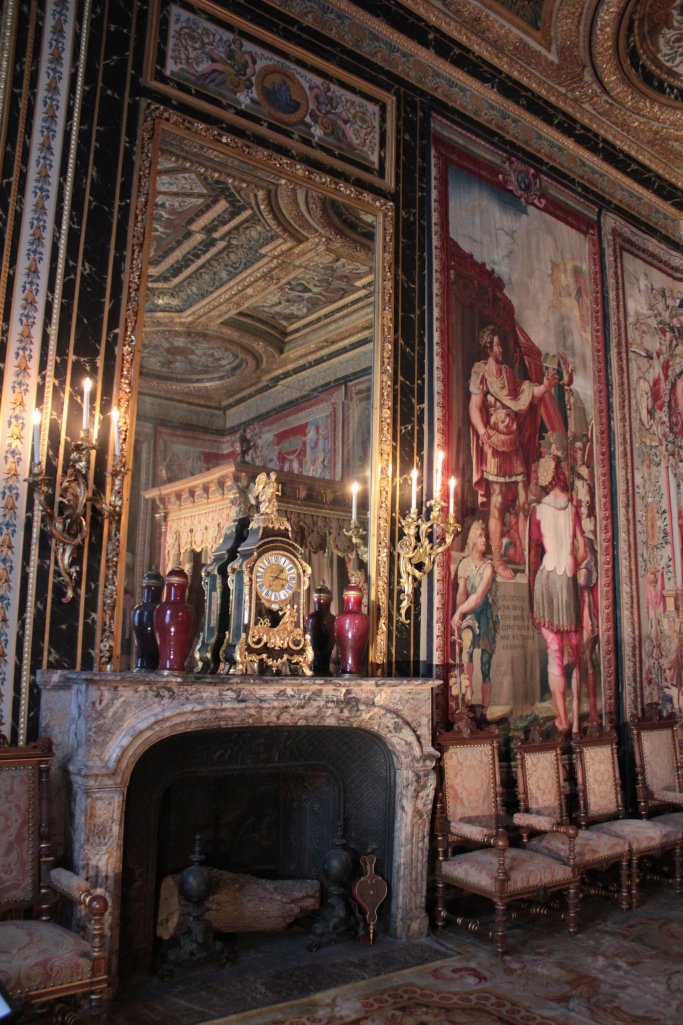
The place is opulent, extravagant, not a hint of humility. Mistresses housed with the family, even accommodated in the crest on the wall in the ballroom, cleverly designed so it could be either wife or favourite "other". I state the bleeding obvious to mon cher: "they really loved themselves, didn't they". Meanwhile, back in the villages, the peasants were keeping themselves busy........


The grounds of the château are vast and it's easy to imagine the royals strolling amongst the trees, enjoying the lakes and grassed areas at what was originally the front grand entrance to the property. We stroll too, beyond the lakes to the edge of the forest to try and capture this panorama. The ducks and swans on the lakes have probably lived here for generations too, their great great great grandfathers would have a tale or too to tell, I'm sure.


Tuesday, 9 April 2013

A château in the 'burbs

7/4/13 Sunday
The Metro lines in Paris are denoted by their final destinations. So if you want to know which platform to stand on (and it can be a bit daunting at times if you're not sure), you need to know which direction you're going. For example, line 1, which is one of our local lines from Bastille, goes in two directions - the signs in the Metro say La Défense and Ch. de Vincennes. We've never really taken much notice of what these directions mean, we just know that La Défense goes in towards town, and Ch. de Vincennes goes back towards home. That is until yesterday when we collected a few tourist brochures, one of which is for Le Château de Vincennes - oh! that's what that means!! And it's so close - only 7 Metro stops, a mere 10 minutes or so. Right in our own backyard, it would seem.
Paris has turned on sunshine and blue sky again today, so after enjoying the sunny markets this morning we don't want to spend the afternoon inside. The weather forecast for this week is not promising, so we need to make the most of the sunshine. And what better way than to take our time exploring a medieval castle in the 'burbs (read: les banlieues, the regions of Paris that lie beyond the 20 arrondissements).
The Metro station is literally right outside the front drawbridge of the Château - the imposing entrance soars above us just beyond a large moat - intimidatingly impressive!!


This fortified royal residence began as a hunting lodge in the 1100s and was then added to by John the Good in the 1300s. Charles V completed work on the keep, with a protective wall, nine towers and a massive moat.


Many monarchs took refuge behind the huge castle walls in the troubled 16th and 17th centuries, and the once royal residence then became a major arsenal when Louis XIV moved to Versailles.  Napoleon Bonaparte had the 9 peripheral towers removed so he could use artillery against anyone who tried to attack him, without them sneaking up behind the towers.


Several well-known people in history were imprisoned here, in particular the debauched Marquis de Sade. Others were imprisoned without cause, simply for writing something that the monarchy didn't like, or if they were too difficult for their family to deal with! There would be no escaping these huge thick walls and enormous heavy doors with solid bolts.


The church on site, Saint Chapelle, is simple but beautiful, and it's possible to climb up the steps to the mezzanine to view the interior from above.


After our tour of the château, we walk around the perimeter of the walls, enjoying the sunshine and marvelling at the structure, which is so uniquely impressive and starkly beautiful that people come to have their wedding photos taken here :-)


This château isn't as well-known or anywhere near as extravagant as the other more famous ones (Versailles, for example) but for the cost of a Metro ticket to get here and a small entrance fee, it's well worth an afternoon visit.